react-native-workers
Web Worker–style multithreading for React Native. Each worker runs your
JavaScript in a separate Hermes runtime on its own thread, with
postMessage/onmessage semantics, structured-clone messaging, timers, and
access to native modules — a headless React Native with no UI.
Write a worker in its own file:
self.onmessage = (e) => self.postMessage({ doubled: e.data * 2 });
Load it by path and talk to it:
import { Worker } from '@ammarahmed/react-native-workers';

const worker = new Worker('./workers/double');

worker.onmessage = (e) => console.log(e.data); // { doubled: 42 }
worker.postMessage(21);
File workers need a one-line Babel plugin;
for a throwaway snippet you can also pass { inline: '…code…' } instead of a path.
Why
React Native runs all your JavaScript on a single JS thread, dispatching UI
updates from it to the separate UI thread. Heavy work — parsing, crypto,
image/data processing, database work, physics — blocks that JS thread, so it
can't drive updates and the UI janks. react-native-workers moves that work to
real OS threads running real JavaScript, so the JS thread stays free.
Unlike a plain thread pool, a worker is a full JS environment: timers, promises,
fetch where available, and — uniquely — native modules. And unlike
postMessage-only libraries, it ships a whole spectrum of fast data-sharing
primitives, from async messaging down to raw shared memory.
What you get
- Real Web Worker API —
new Worker(...),postMessage/onmessage,terminate,MessageEvent, structured clone, timers, error propagation. - Native modules inside workers — call C++ (Cxx) modules, platform
(Java/ObjC) TurboModules and legacy modules from a worker; subscribe to
NativeEventEmitterevents. - Expo Modules inside workers —
requireNativeModule(...)works in a worker on both iOS and Android: constants, sync and async functions, live properties, and module events. - Nested workers — a worker can spawn its own workers.
- A spectrum of shared data:
SharedStore— synchronized, watchable, granularly-patchable shared state (lazy reads,setIn,subscribeIn).SharedValue— a single synchronous cell, lock-free for numbers (~17M writes/sec).SharedBuffer— true zero-copy shared memory across runtimes for bulk numeric work.
- Typed RPC — the JSModule bridge and
defineModulelet host and worker call each other's functions like localasyncfunctions, fully typed. UIWorker— a worker whose JS runs on the platform UI/main thread. Its runtime is shared and persistent by default, so it survives navigation.Thread(experimental) — run a worker's own runtime on another thread for the length of a callback: no second runtime, nothing serialized, every captured binding intact. Opt in per worker.- Debuggable — every background worker is its own
DevTools target (breakpoints, stepping, sources), and
consoleoutput is forwarded to the host, tagged with the worker's name. - Fast, small bundles — release worker bundles are precompiled to Hermes bytecode and ship ~150 KB each, not the ~1.4 MB of the full framework.
See it running
Everything on this site is demonstrated by the example app — one screen per feature, all runnable on a simulator or device. These are captures of it on iOS:
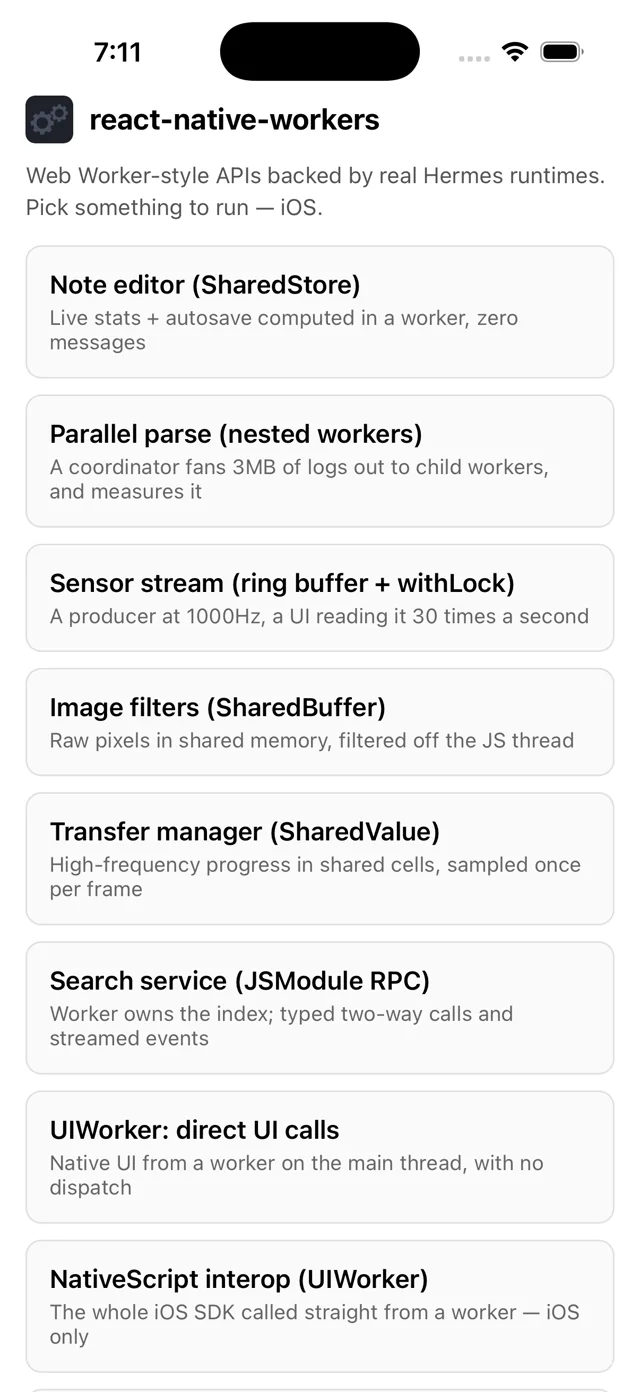
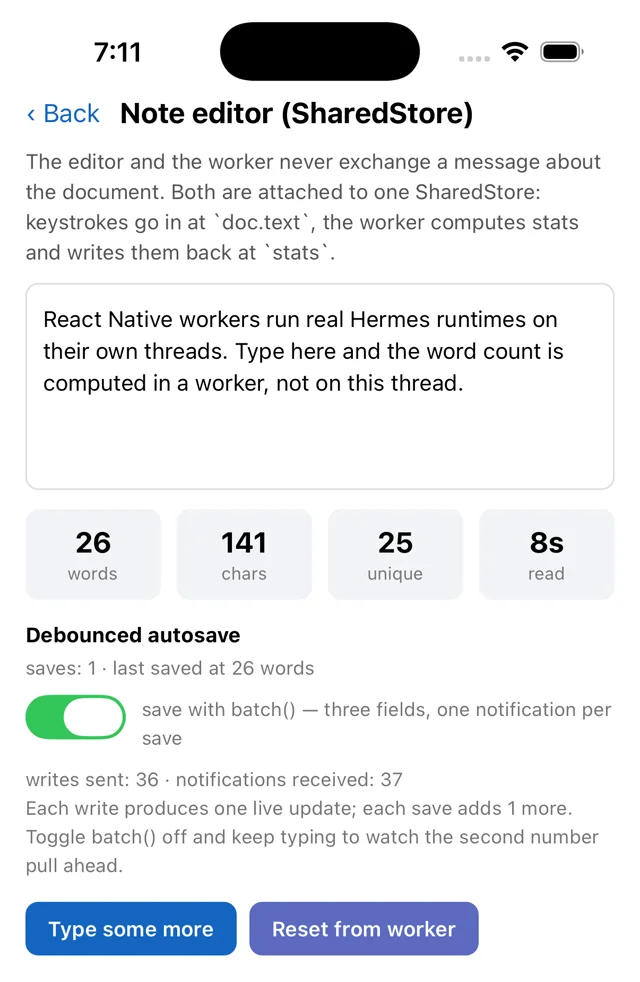
SharedStore.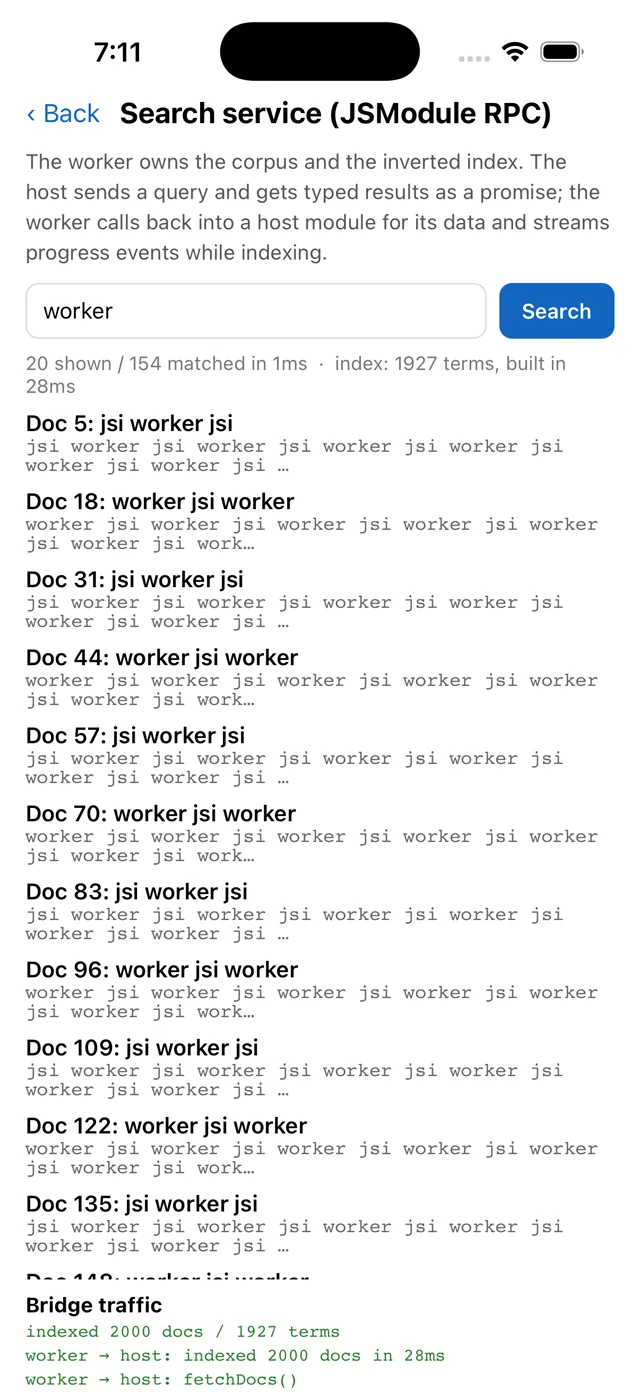
Requirements
- React Native with the New Architecture (bridgeless) and Hermes.
- RN 0.81.4+ (developed against 0.86).
- iOS and Android.
Where to next
- Installation — add the package and (on Android) register native modules.
- Quick start — your first worker in five minutes.
- Creating workers — lifecycle, options, nesting.
- Shared data — pick the right primitive for your workload.